The SWRB SA has taken a collaborative and considered approach to define the scope of practice, social work services and exclusions, to determine who needs to register and why.
The scope of practice describes the profession, its breadth and diversity, as well as the knowledge, values and skills that underpin social work. The scope of practice is social work identity.
Social work services sit within the scope of practice and is a narrow definition of specific work that is protected. Only a registered social worker can undertake social work services. The Act enables the protection and regulation of this work.
Exclusion is a legal mechanism which limits who falls within the definition of social work services.

A scope of practice defines the activities, roles, and responsibilities that a particular profession or field is authorised to undertake. The purpose of a scope of practice is to clarify professional boundaries, set practice standards across a profession, allow for effective regulation, and to protect the public.
The SWRB SA was required by the Act to describe one or more scope of practice and to specify qualifications leading to registration.
The scope of practice does not determine who needs to register, the definition of social work services is the mechanism used to determine this (see below).
The SWRB SA scope of practice provides an overarching description of social work practice in South Australia. The SWRB SA has established one general scope of practice. In the future, more specialised scopes may be introduced.
Social work is undertaken in a variety of settings and roles, whether remunerated or not. Social work is not restricted to the provision of direct client services. It also includes using professional knowledge in non-direct contexts such as working in management, administration, tertiary education, research, advisory, regulatory or policy development roles, and any other roles that impact on safe, effective delivery of services in the profession.
Social work is a practice-based profession and an academic discipline promoting social change driven by a need to challenge and change those structural conditions that contribute to marginalisation, social exclusion, and oppression. Social Work promotes social development, social inclusion and cohesion, and the empowerment and liberation of people.
Respect for inherent worth & dignity of human beings, doing no harm, respect for diversity, collective responsibility, and upholding human rights and social justice are the guiding principles of social work.
Underpinned by theories of social work, social sciences, and humanities, social work engages people and structures to address the impact of social problems and enhance wellbeing. Aboriginal and Torres Strait Islander knowledges belong to Aboriginal and Torres Strait Islander peoples. Aboriginal and Torres Strait Islander knowledges are ways of being, doing, and knowing. Non-Aboriginal and Torres Strait Islander social workers cannot claim to be ‘knowers’ of Aboriginal and Torres Strait Islander knowledges, however they must be aware of, engage with and respect, Aboriginal and Torres Strait Islander knowledges. Social Work has a responsibility to contribute to research and knowledge building to advance theories that are applied and emancipatory.
Social work as a profession and academic discipline engages in critical thinking which means that social workers are skilled at questioning, examining, interpreting, and evaluating information and situations. Critical thinking is not criticism but rather it is maintaining a questioning and evaluative stance, informed by analysis of power relations in practice and decision making. Critical reflection is the link between thinking and doing which enables a social worker to make decisions that can be scrutinised by others, ensuring accountability as the basis for better practice in the future. Critical thinking and reflection are grounded in self-awareness. Self-awareness requires a high level of understanding about who we are and how we behave as individuals and as a society.
As a relationship-based profession, social work requires an advanced level of interpersonal, and communication skills, underpinned by strong self-awareness to assess and intervene in people’s lives. Social workers therefore aim to establish caring and respectful relationships with authenticity, intention, and purpose, to strengthen, restore and uphold the safety and wellbeing of those they work with. Social Work operates and collaborates within and across service systems and other professional disciplines to enhance service delivery.
Social work services is the specified work that SWRB SA is protecting and regulating, and it sits within the scope of practice.
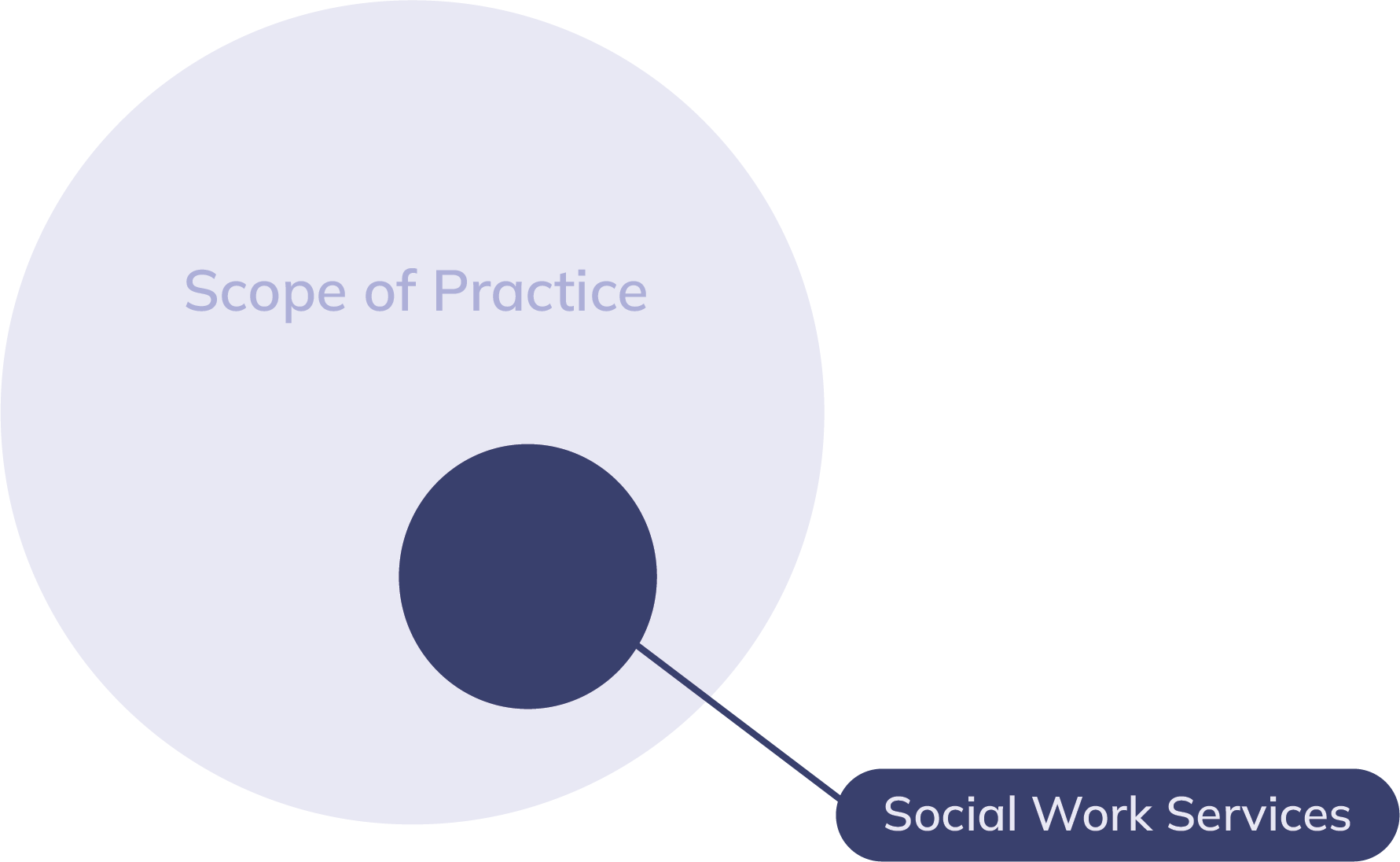
Social work services refer to the work that only a social worker can do, based on their training, expertise, and the needs of a client or community.
Social work services are more narrowly defined than the scope of practice and is the protected work that the SWRB SA is required to define by the Act. The definition of social work services is the key mechanism that determines who must register with the SWRB SA.
The SWRB SA social work services legal definition is:
A natural person undertaking psychosocial assessments, and analysis, and interventions to holistically evaluate the context of a person’s or peoples’ situations and their environments; for the purpose of identifying and responding to risk; and/or violence; and/or trauma; and/or harm.
Please see our explainer for to understand psychosocial assessments.
Anyone that undertakes social work services will need to register unless they are excluded (see below).
SWRB SA regulations acknowledge a range of other professionals who may also undertake work within the definition of social work services.
‘Exclusion’ is a legal mechanism that allows non-social workers to undertake this work without being registered with the SWRB SA.
The following professional categories are not required to register:
- Practitioners registered with the Australian Health Practitioner Regulatory Agency (AHPRA) who are working within their professional scope of practice; and
- Cultural advisors, and others employed for their cultural knowledge and expertise, in so far as they are providing cultural advice and/or guiding conversations on cultural business using cultural knowledge.
- Police officers acting in their capacity as a Police officer; and
- Counsellors accredited with the Australian Counselling Association or the Psychotherapy and Counselling Federation of Australia, or rehabilitation counsellors accredited with the Australian Society of rehabilitation Counselling who are practising within their professional scope of practice; and
- Accredited Family Dispute Resolution practitioners as defined in Family Law (Family Dispute Resolution Practitioners) Regulations 2008.
The following groups are also not required to register:
Those undertaking caring duties such as:
- Foster care,
- Kinship care,
- Residential care, or
- other duties to support individuals with activities of daily living and not providing social work services
Other roles that are not required to register are:
- Support workers,
- Youth workers,
- Peer support workers
- Lived experience workers, and
- Other paraprofessionals providing support and assistance using their skills and knowledge from their training and not providing social work services.
There are clear boundaries between people who deliver social work services and those who are not permitted, or should not be expected, to deliver social work services.
Please read the Guide to Social Worker Registration and, if you have concerns, speak with your employer about your specific situation.
We have created an explainer for the definition of social work services if you would like to download it.
If you would like further clarification about whether your role is within the definition of social work services or excluded, please contact swrbregistration.com.au